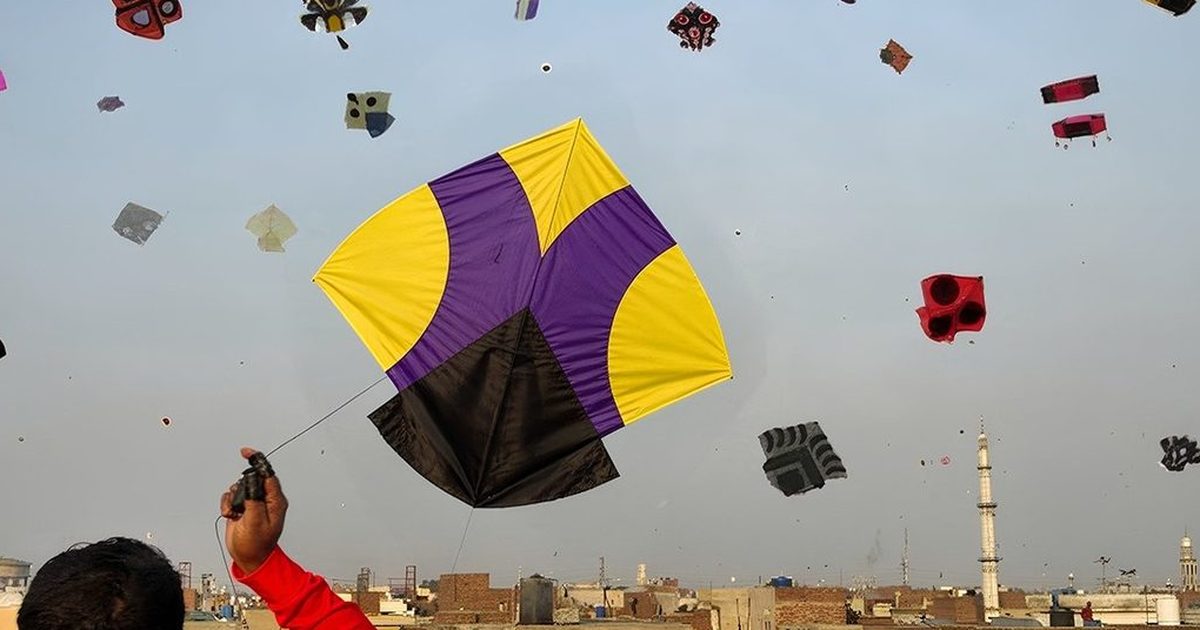
"Who won Basant?" is a question with no answer, and it has never had one. Lahore flies the most competitive kite in the world and has never had a federation, a rulebook, a referee or a title. What it has is a city full of roofs, each of which believes it won.
That matters practically, because people do ask whether there is a tournament to enter, and whether a competition can be organised in 2027. The short answers are no, and yes-but. Here is what sits behind both.
There is no governing body, and that is not an oversight
No federation sanctions kite fighting in Pakistan. No published code defines a legal cut, a foul, a heat or a winner. There is no ranking, no registration of competitors as competitors, and no record of results.
The reason is the shape of the game. A pech happens between two roofs that may be three streets apart, witnessed by whoever happens to be on them, resolved in under a second, and claimed by both sides. There is no neutral observer by design: the sky is the field and nobody owns it. How a pech is won and lost is technique, and the technique is genuinely competitive — it just has never been scoreable.
What Lahore had before the ban was competition without a competition: roofs keeping their own count, side bets that nobody wrote down, the status of being the roof other roofs avoided. The eighteen-year ban ended that culture's continuity, and nothing has replaced it.
What is lawful in 2027
Flying is lawful in Punjab only on the days and at the places the Government notifies, by someone registered, using cotton line within the published limits — the frame is set by the Punjab Kite Flying Act 2025, and Basant 2027 is announced for 12 to 14 March.
A competition is therefore not a separate category of thing. It is an event inside that window, and every requirement that applies to flying applies to it, plus the ones that apply to gathering people in one place: a permitted venue, SOP compliance, first aid on site, and control of what everybody is flying with.
No sanctioned competition has been announced for 2027. Nothing has been notified, because the SOPs themselves have not been — cabinet approval of the dates was still pending at the time of writing.
What 2026 actually produced: arenas, not tournaments
The closest thing to organised competitive flying last year was the fenced kite-flying arena at the ticketed festivals. The DHA EME listing sold a tier that added two hours of exclusive access to the arena on top of the standard ticket, and the SOPs required ticket holders to buy their kites and material from the on-site vendors.
Read that as a sporting arrangement rather than a commercial one and it is more interesting than it looks: an enclosed space, a fixed time slot, and every competitor flying identical equipment bought from one supplier. That is the basic apparatus of a fair contest. It was built for safety and liability reasons and it happens to solve the problem that made competitive kite fighting unjudgeable.
If you want to organise one in 2027
Not advice on how to get permission — that is the district administration's to give — but the shape of the thing you would be proposing.
A venue, not a neighbourhood. A ground, an enclosure, a specific roof with sightlines that an official can stand in. A competition spread across a mohalla cannot be supervised and will not be permitted.
Inside the notified days. If the Government notifies 12–14 March, the event is on one of those three days or it does not exist.
One supplier, identical equipment. The single most important sporting decision and the easiest compliance win. Every competitor flies the same grade of kite and the same cotton dor, issued on site, on QR-coded pinnay that can be checked. Nobody brings their own. This is what makes a result mean anything, and it is also what stops the event becoming an arms race.
A neutral spotter per pair. One person per contest whose only job is to call the cut and whose call is final. Without this, every heat ends in an argument.
Written rules, however short. What counts as a cut; what happens if both lines go; whether a kite that drifts into another contest is out; a time limit, because two careful flyers can avoid each other indefinitely; and a safety stop that any official can call.
Everything the SOPs require. First aid on site, the parapet standard if any part of it is on a roof, and the rooftop requirements in full. Also no DJ, which surprises organisers every year.
A line-check at entry. Someone physically looking at every spool before it goes in. Chemical dor does not announce itself, and one competitor with coated line turns your event into an incident.
The prize problem, which is the real reason to be careful
This is the part worth thinking hardest about, and it is the reason to be slow rather than enthusiastic.
A prize for cutting is a subsidy for dangerous line. The moment a cut is worth money, the incentive to fly something that cuts better than cotton becomes financial rather than social — and the thing that cuts better than cotton is the metallic and glass-coated line that killed and maimed people for years and got the festival banned for eighteen of them. Every structural problem Basant has had runs through that one incentive.
If you design a competition, design the prize so it does not reward the cut directly. Reward the longest flight, the highest kite, the best-made kite, the cleanest roof, the youngest competitor who completed a heat. Or keep the prize symbolic and let the status do the work — which, for a hundred years, is exactly what it did.
Outside Punjab
Khyber Pakhtunkhwa's 2006 Act lets a district notify specified places for flying and the sale of kites for up to fifteen days in the spring, with prior approval of the provincial government. That is a legislative route to an organised spring event, and it is the only one outside Punjab we could find — everywhere else either prohibits flying by statute or bans it periodically under Section 144.
Frequently asked
Is there an official kite flying competition in Pakistan?
No. There is no federation, no published rulebook and no sanctioned tournament, and none has been announced for 2027. Competitive flying in Lahore has always been informal — roof against roof, with each side keeping its own count.
Can I organise a kite competition for Basant 2027?
Only as an event inside the Government's notified days, at a permitted venue, meeting the Basant SOPs in full — first aid on site, compliant equipment and a venue an official can supervise. Permission comes from the district administration, and the SOPs for 2027 had not been notified at the time of writing.
How is a kite fight scored?
There is no standard scoring. A pech is settled when one line is cut, and with no neutral observer both roofs commonly claim it. A structured competition would need a spotter per pair whose call is final, a time limit, and written rules on what happens when both lines go.
What is a kite flying arena?
An enclosed flying area at an organised festival, sold in timed slots. At DHA EME in 2026 a higher ticket tier bought two hours of exclusive arena access, and ticket holders had to use kites and material bought from the on-site vendors.
Why is prize money for kite fighting risky?
Because it rewards cutting, and the line that cuts best is the metallic and chemically coated line that is banned, and that caused the deaths behind the original ban. A competition should reward flight — height, duration, craft — rather than paying per cut.
Kites, dor and everything that goes with them
Kites by the tawa grade, 100% cotton dor on QR-coded pinnay, gloves and tape — all sold singly from Lahore at a published price, delivered by our own rider. See the products and prices.
Selling is paused while our registration is suspended by the Punjab Government — see the notice. The products and prices stay published so you can plan, and we answer questions either way.
- Patang & gudda
- Cotton dor
- Pinnay
- Gloves
- Tape
- Delivery in Lahore
Sources
- Bookme — Basant Fest DHA EME Lahore, arena access and on-site vendor requirement
- Arab News — Punjab imposes curbs ahead of Basant kite festival's return after 18-year hiatus
- Khyber Pakhtunkhwa Prohibition of Kite Flying Activities Act, 2006 — full text, KP Code
- FAFEN — Kite flying regulation: how it evolved since 2001