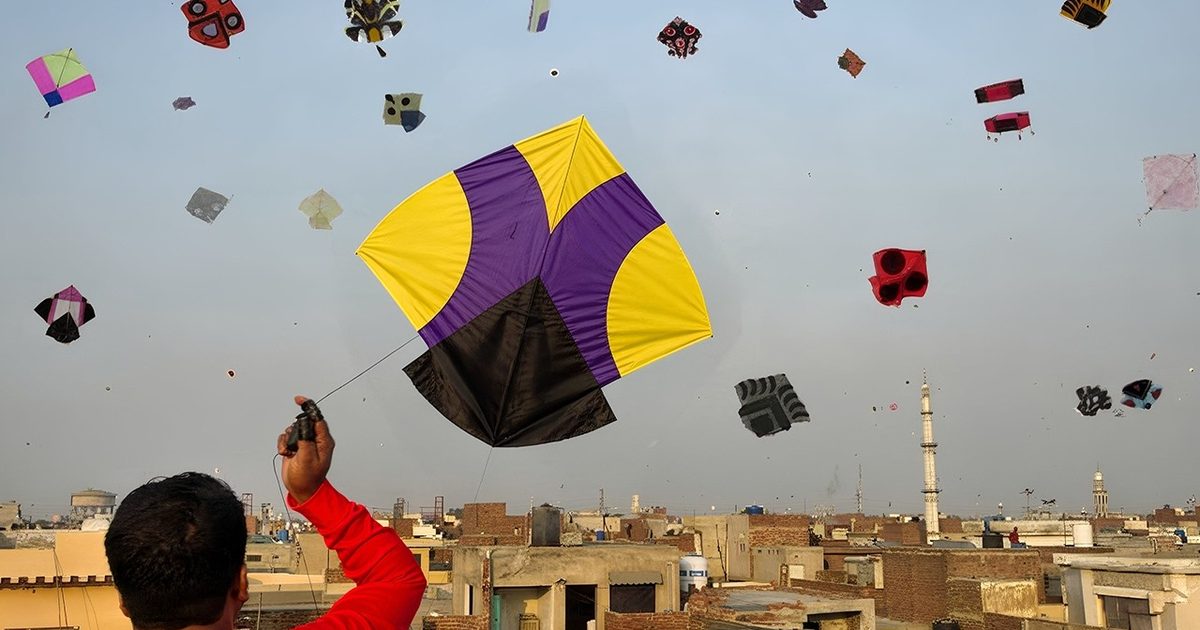
Kite fighting in Lahore is the pech (پیچ): two flyers cross their lines and work them against each other until one is cut. It is the contest that makes the Basant sky a fight rather than a display, and it is decided by handling far more than by the kite.
The basics of flying — tying the kanni, launching, holding a line — are on the flying guide. This page starts where that one's pech section stops.
Two ways to fight: dheel and khench
Dheel (ڈھیل) is letting line out fast while the lines are in contact. The moving line saws across the other one, and on cotton it is the more common way to win. It needs a lot of line available and someone managing the pinna.
Khench (کھینچ) is pulling line in fast instead. It is quicker and more aggressive, and it works best when you are above the other kite and close. Get it wrong and you are hauling a cut kite back on a slack line.
Most flyers have a preference. Good ones read the pech and choose.
Reading the contact point
Where the lines touch is where the fight happens.
- Height matters. The kite above usually has the advantage, because its line comes down across the other one.
- Angle matters. A shallow crossing gives a long contact and a slow fight. A steep one is short and sudden.
- Keep moving. A rigid line held still generally gets cut. Line moving through the contact point — out in dheel, in with khench — does the cutting.
- Watch the other kite, not yours. When it starts to wobble or drop, their line is going.
When to break off
Not every pech is worth fighting. Break off when you are below and losing height, when your kite is too small for the wind, or when the other line is crossing a road or a neighbour's roof full of children. Losing a Rs 350 kite by walking away is cheaper than any of the alternatives.
Choosing the kite for a pech
A gudda is the fighting kite: more sail, more pull, more control in the contact. The 1 tawa is the everyday choice. The 1.5 tawa wants steady wind and a firmer hand, and pulls hard enough that gloves stop being optional.
A rule of thumb every experienced flyer repeats: never fight a pech with slack line. Before you cross, take up the slack so you can feel the other line the moment it touches. A slack line cannot be worked — you cannot let it out fast or pull it in fast — and the flyer who is feeling the contact first is usually the one who wins it.
The rules of a fair pech
Cotton against cotton. Only plain cotton dor on a QR-coded pinna is legal, and that is what makes pech a contest of skill. Coated line and manjha are banned, carry three to five years, and turn a game into the thing that killed people — how to spot it.
No charkhi. Line must be flown from a pinna. Why the charkhi is banned.
Bo kata, then let it go. When a line is cut, the shout is bo kata and the kite drifts loose. Do not chase it. Chasing cut kites across roofs, trees and poles is how people die every season — two people died falling from trees and one was electrocuted on a pole in 2026.
Stop at dark. There is no night flying under the SOPs.
Frequently asked
What is kite fighting called in Pakistan?
Pech (پیچ): crossing your line against another flyer's and trying to cut it.
How do you win a pech?
Usually by keeping your line moving through the contact point — letting it out fast (dheel) or pulling it in fast (khench) — and by being above the other kite.
What is the difference between dheel and khench?
Dheel is letting line out fast during a pech. Khench is pulling it in fast. Dheel is the more common way to win on cotton.
Is kite fighting legal in Lahore?
Yes, on the permitted Basant days, with plain cotton dor on a QR-coded pinna. Coated line, manjha and charkhi are banned.
What should I do when my kite is cut?
Let it go. Chasing a cut kite is one of the ways people die at Basant.
Kites, dor and everything that goes with them
The 1 tawa gudda is Rs 350 and the 1.5 tawa is Rs 450. Cotton dor on a QR-coded 2-piece pinna is Rs 8,000, and gloves are Rs 750 per person. See the products and prices.
Selling is paused while our registration is suspended by the Punjab Government — see the notice. The products and prices stay published so you can plan, and we answer questions either way.
- Patang & gudda
- Cotton dor
- Pinnay
- Gloves
- Tape
- Delivery in Lahore