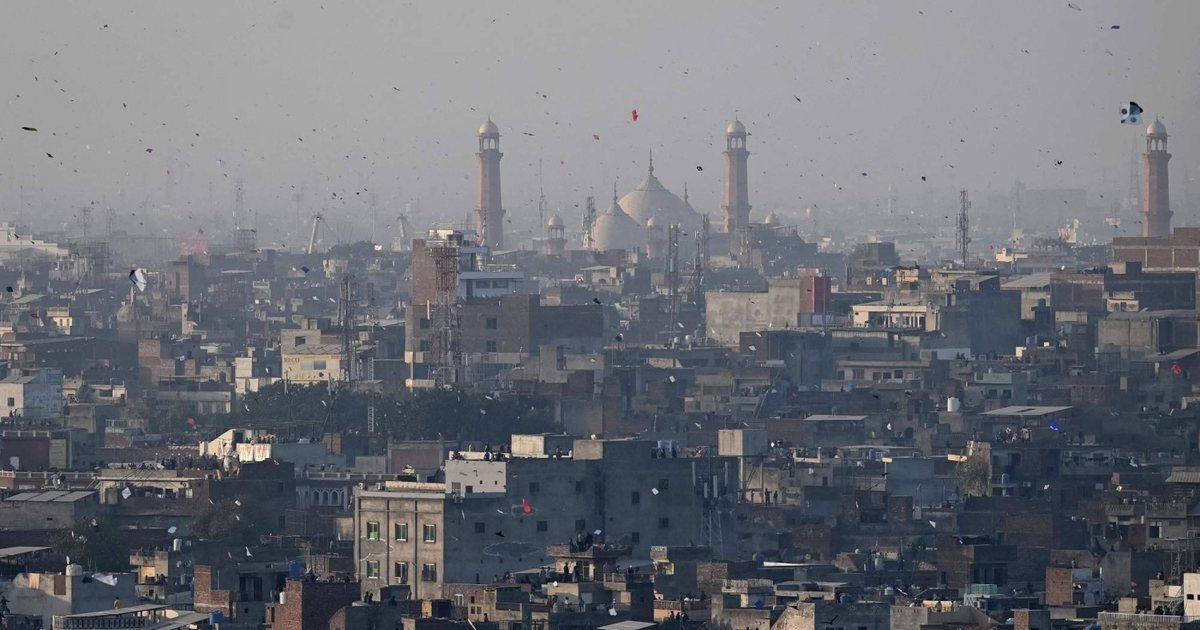
Most accounts of Basant skip the difficult middle. They describe an ancient spring festival, mention that it was banned, and move on to the revival. The middle is the part worth understanding, because it explains every rule now attached to the festival.
Origins: a spring festival, not a kite festival
Basant began as a seasonal observance across the Punjab, marking the end of winter and the yellow of the mustard fields. Kites attached themselves to it over time, and the association deepened in Lahore specifically — a dense, walled, flat-roofed city where an entire population has natural access to the sky.
By the Mughal period and through the colonial era, spring kite flying in Lahore was an established custom. Kite making became a neighbourhood craft: paper, split bamboo, and cotton line spun and wound by families in the quarters around the Walled City, Mochi Gate among them.
The twentieth century: from custom to spectacle
Through the second half of the twentieth century Basant grew from custom into event. Rooftop parties became organised and competitive. Hotels filled. Visitors came from across the country and abroad. The festival acquired a commercial scale that the old craft economy had never anticipated.
With scale came competition, and competition changed the equipment. The object of pech is to cut the other line, so demand concentrated on whatever cut best. Cotton, which had always been the material, began to lose ground.
The string
This is the hinge of the whole story.
Flyers moved to nylon cord, to metallic wire, and to cotton coated with abrasive preparations — powdered glass bound with rice paste and gum, sold as maanja, and later chemical coatings. These materials hold an edge in a way plain cotton does not.
A taut, coated line strung invisibly across a street at the height of a motorcyclist's throat is a blade. Riders died. Children on roofs fell. Metallic line caught overhead cables and electrocuted people, and in some years caused grid faults across neighbourhoods. Celebratory aerial firing added its own toll.
These were not rare accidents. Each season produced a recognisable pattern of deaths, and by the early 2000s that pattern had become politically impossible to ignore.
Worth stating plainly: the festival was not stopped because anyone objected to kites, to spring, or to rooftop parties. It was stopped because of what people had started tying to their kites.
The ban
Prohibition arrived through the courts and then through legislation. From 2005 kite flying in Punjab was subject to court-ordered bans, hardened by supporting law over the following years. Enforcement varied; the festival surfaced intermittently and was suppressed again.
The effect on Lahore was total in one sense and partial in another. The organised, city-wide Basant ended. The craft economy around it contracted sharply, and a generation grew up in Lahore having never flown a kite at Basant. Yet illegal string never fully disappeared, which is precisely the problem the current framework is designed around.
The return
In December 2025 the Provincial Assembly of the Punjab passed the Punjab Regulation of Kite Flying legislation, revoking the prohibition-era law and replacing it with a regulatory regime. Rules under the Ordinance were notified in the same month by the Government of the Punjab, and the framework gives the government and the Deputy Commissioner Lahore power to permit kite flying on specified days, times and locations.
Basant 2026 was held on 6–8 February 2026 — the first legal Basant in roughly twenty years — with public holidays declared on 6 and 7 February. Basant 2027 follows on 12–14 March 2027.
What the revival actually changed
The returned festival is narrower than the one people remember, and deliberately so:
- Licensing replaced the open trade. Manufacturers, traders, sellers and associations register in separate categories through the Basant Festival 2027 portal, via eBiz Punjab.
- Materials are specified in law. Cotton dor only, maximum 9 tar, minimum 28 count, wound as a pinna carrying a QR code. Charkhi are prohibited. Kite sizes are capped. The full material rules are worth reading once, properly.
- Penalties are severe. Flying with banned string: 3–5 years and/or up to Rs 2 million. Manufacturing, trading or selling it: 5–7 years and/or up to Rs 5 million. Cognizable and non-bailable, with officers of sub-inspector rank able to arrest without warrant.
- Rooftops are regulated. Boundary walls of at least 3.5 ft, first-aid kits, no running or leaning over edges, owners and organisers jointly liable, with a compliance deadline of 30 December 2026.
- Manufacturing geography opened up. An earlier plan confining production to five zones — Walled City, Misri Shah, Shad Bagh, Baghbanpura among them — was withdrawn on 5 September 2026. Licensed makers may now produce anywhere in Lahore at their approved address.
Is it permanent this time?
Honestly: that depends on the string. The framework is built precisely around the thing that caused the deaths, and the stated 2027 position is zero tolerance on chemical-coated line and metallic wire. Punjab Police enforcement began well before the season, with seizures and arrests reported through September 2026.
If illegal dor stays out of the sky, the festival has a future. If it returns at scale, the history in this article suggests what follows. That is not a rhetorical flourish — it is the actual mechanism by which Lahore lost Basant the first time.
Frequently asked
Why was Basant banned in Pakistan?
When was the last Basant before the ban?
When did Basant return to Lahore?
What law governs kite flying in Punjab now?
How old is the Basant festival?
Kites, dor and everything that goes with them
We supply complete Basant kits from Lahore — kites in the legal sizes, 100% cotton dor wound on QR-coded pinnay, and the gloves and tape that stop the afternoon going wrong. Matched to work together, at published prices.
- Patang & gudda
- Cotton dor
- Pinnay
- Gloves
- Tape
- Delivery in Lahore
Selling is paused while our registration is suspended by the Punjab Government — see the notice. The packs and prices stay published so you can plan, and we answer questions either way.