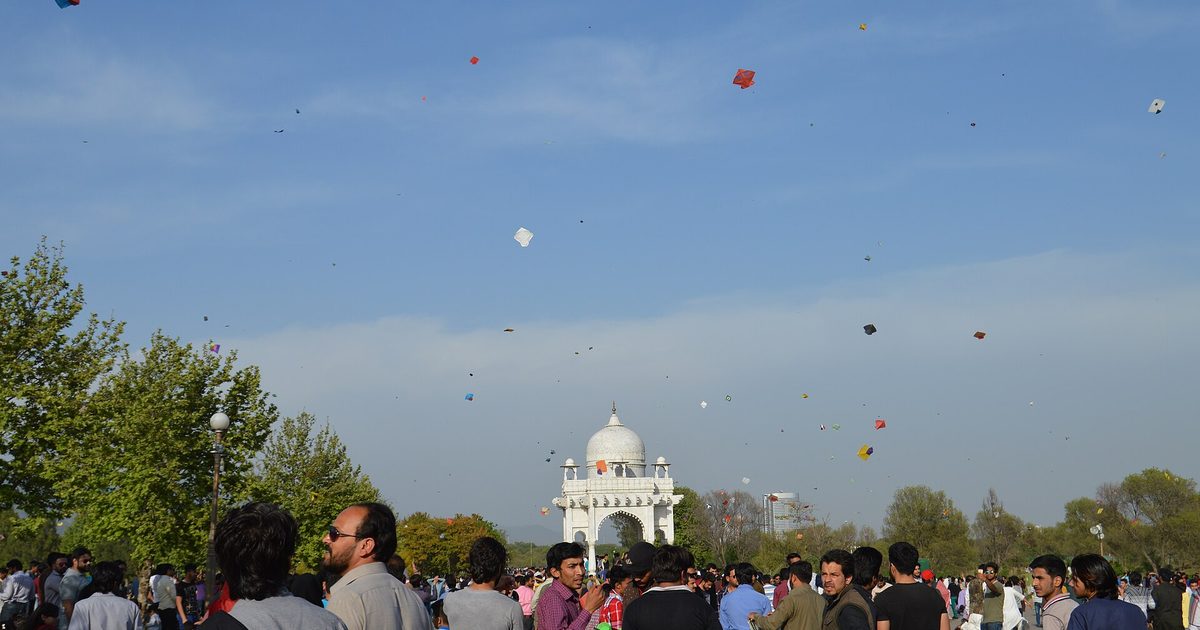

Almost everything written about kite flying in Pakistan is written about Punjab, and almost all of it stops at the provincial border. That is a problem if you live in Karachi, Islamabad or Peshawar, because the question people actually ask — is it legal where I am? — has a different answer in each, and in one province it has an answer with a date on it.
The short version: Punjab is the exception, not the new normal. One province built a licensing regime and reopened the festival. Nowhere else did.
Where Basant is legal inside Punjab covers the districts. This page covers everywhere the Punjab Act does not reach.
Punjab, for comparison
Flying is lawful in Punjab only on the days and at the places the Government notifies, by a person registered through the portal, using cotton line within the published limits. The Punjab Kite Flying Act 2025 sets the offences and the penalties behind that; everything else on this site is written inside that frame. Basant 2027 is announced for 12 to 14 March.
That structure — a general prohibition with a notified window cut out of it — is the model to hold in mind, because one other province has the same shape and the rest do not.
Khyber Pakhtunkhwa: a statute, and a fifteen-day door
KP is the only other province with a kite-specific Act on the books, and it is worth reading because it is both older and, on paper, narrower than Punjab's.
The Khyber Pakhtunkhwa Prohibition of Kite Flying Activities Act, 2006 (KP Act No. IV of 2006, assented 12 May 2006) extends to the whole province. Section 4(1) prohibits three things: committing or abetting an act of kite flying; manufacturing or selling a kite; and manufacturing, storing or selling metallic wire, nylon cord — tandi — or any thread coated with sharp maanjha.
Two details in the definitions do more work than the prohibitions:
- **"Kite flying" means flying a kite at any place with or without metallic wire**, nylon cord or coated thread. The method is not the offence; the flying is.
- "Place" is defined extremely widely — street, road, thoroughfare, park, garden, playground, graveyard, hotel, restaurant, motel, mess, club, house, building, tent, vessel, any roof and open space, and the area within a 6-kilometre radius of an airport or airbase. There is no private-roof exemption. Your own roof is a "place".
The penalties. Under section 4(3), contravening the prohibitions carries imprisonment of up to three months, or a fine of up to Rs 40,000, or both. Separately, section 5 requires every manufacturer, trader or seller of kites or kite-flying material to register with the district government, and failing to register carries a much heavier punishment — up to three years, or up to Rs 100,000, or both. The trade, not the flying, is what the Act hits hardest.
Section 3 makes offences under the Act cognizable and non-bailable, triable summarily, and section 6 lets a police officer of ASI rank or above arrest without warrant, enter, search and seize.
And the door. Section 4(2) lets the Nazim of a district, by notification issued with the prior approval of Government, allow kite flying at specified places and the sale of kites for a period not exceeding fifteen days during the spring season in a year. Manufacturing may be allowed for whatever period Government specifies. Flying near an airport or airbase may never be allowed, and the explanation makes clear that nothing in the exemption permits metallic wire, tandi or coated thread.
So a lawful spring festival in Peshawar or Abbottabad is not a legislative problem. It needs a district notification and provincial approval, and it would run for fifteen days at most. Whether any district has issued one is a question for that district administration — we could not verify a current notification either way, and the honest answer is that the Act permits it and we have no evidence of one being in force.
This also sets the frame for the kite markets in Peshawar and Haripur. Manufacture and sale in KP are not categorically impossible; they are registration-dependent, and the registration offence is the three-year one.
Karachi: no statute we could verify, and Section 144 instead
Here the honest answer is more useful than a confident one.
We could not find a Sindh kite-flying Act. Searches of news coverage and assembly records did not produce one, and the widely repeated claim that Sindh bans kite flying province-wide traces back to a commercial kite retailer's blog post that names no statute, no year and no section. We are not going to repeat it as law.
What is documented is Karachi's use of Section 144. In 2024 the Karachi Commissioner, Muhammad Saleem Rajput, issued a notification under Section 144 of the Code of Criminal Procedure imposing a complete ban on the manufacture, sale and flying of kites inside the city, and on the manufacture, sale and use of string, cord, and metallic and nylon wire — maanjha. The stated grounds were danger to human life and disturbance of public peace. It ran 30 March to 29 May, and SHOs were authorised to register FIRs under Section 188 of the Pakistan Penal Code for disobeying it.
The mechanism matters more than that particular order. A Section 144 order is an executive instrument with a maximum life of two months, which is why Karachi's kite bans keep reappearing: they expire and are reissued rather than standing permanently. So the question in Karachi is never "is there a law?" but "is an order in force today?", and the only reliable answer comes from the Commissioner's office or the district administration, not from a blog — including this one.
Sindh has also used Section 144 for adjacent things, including a province-wide 60-day ban on drones, quadcopters and helicams in 2026. If you were planning to film from the air, see photographing Basant.
Islamabad: the same instrument, repeatedly
The Islamabad Capital Territory has banned kite flying and kite manufacturing under Section 144 more than once — a two-month notification in 2017 covering selling and flying, and a further Section 144 order in March 2024 after a series of kite-related deaths, with dozens of arrests reported that year.
As in Karachi, these are time-limited administrative orders. We found no kite-specific notification in force in the capital in 2026, and no Basant event of any kind permitted there. Rawalpindi, being in Punjab, sits under the Punjab Act — but a Punjab notification for Basant days has so far meant Lahore, not the whole province.
Balochistan, Azad Kashmir and Gilgit-Baltistan
We have no verifiable material on any of the three: no kite-specific statute, no reported Section 144 order, nothing. Absence of evidence is not permission. The sensible assumption anywhere outside a notified Punjab window is that flying is either prohibited or unregulated-and-unprotected, and that a district magistrate can prohibit it at a week's notice.
What this means in practice
If you are outside Punjab and want to fly in 2027. The only route with a date on it is to be in Punjab on 12–14 March, at a place the Government notifies, with registered equipment. There is no national Basant.
If you are in KP and want a local festival. The Act already provides for it — section 4(2), fifteen days, spring season, district notification with provincial approval. That is a request to a Deputy Commissioner's office, not a campaign for new legislation.
If you are ordering equipment from Lahore. Do not expect it to be shipped. Kites and dor may not travel by courier, post or delivery platform in Punjab, and the goods arriving in a province where sale is an offence creates a second problem on top of the first.
If someone offers to sell you kites in Karachi or Islamabad. Ask what they are registered under. In Punjab there is a portal and a QR-coded pinna to check. In KP there is district registration. In a Section 144 city there is no registration scheme at all, which means there is no such thing as a licensed seller there — only a seller.
Frequently asked
Is kite flying legal in Pakistan?
Only in Punjab, and only within the window the Government notifies. The Punjab Kite Flying Act 2025 allows flying on notified days at notified places by registered people using cotton line. Every other province either prohibits it by statute or bans it periodically by executive order.
Is kite flying banned in Karachi?
Karachi has repeatedly banned the manufacture, sale and flying of kites under Section 144 of the Code of Criminal Procedure — most recently documented in a 2024 notification by the Commissioner that ran 30 March to 29 May, enforced through FIRs under Section 188 of the Pakistan Penal Code. Such orders last a maximum of two months and are reissued, so check with the district administration whether one is in force now.
What is the punishment for kite flying in Khyber Pakhtunkhwa?
Under section 4(3) of the Khyber Pakhtunkhwa Prohibition of Kite Flying Activities Act 2006, up to three months' imprisonment or a fine of up to Rs 40,000, or both. An unregistered manufacturer, trader or seller faces up to three years or Rs 100,000 under section 5. Offences are cognizable and non-bailable.
Can Basant be celebrated legally in Peshawar?
The KP Act allows a district Nazim, with the prior approval of Government, to notify specified places for kite flying and the sale of kites for up to fifteen days in the spring. Flying within six kilometres of an airport or airbase can never be permitted, and metallic wire and coated thread stay prohibited throughout. We have no evidence of such a notification currently being in force.
Is kite flying allowed in Islamabad?
The Islamabad Capital Territory administration has banned kite flying and manufacturing under Section 144 on more than one occasion, including two-month orders in 2017 and March 2024. No Basant event has been permitted in the capital, and no kite-specific registration scheme exists there.
Kites, dor and everything that goes with them
Kites by the tawa grade, 100% cotton dor on QR-coded pinnay, gloves and tape — all sold singly from Lahore at a published price, delivered by our own rider. See the products and prices.
Selling is paused while our registration is suspended by the Punjab Government — see the notice. The products and prices stay published so you can plan, and we answer questions either way.
- Patang & gudda
- Cotton dor
- Pinnay
- Gloves
- Tape
- Delivery in Lahore
Sources
- Khyber Pakhtunkhwa Prohibition of Kite Flying Activities Act, 2006 — full text, KP Code
- Dawn — Kite flying, manufacturing banned in Karachi for two months
- The News — Kite flying banned in Karachi for two months
- Dawn — Kite flying banned for two months in Islamabad
- The Express Tribune — Kite flying, manufacturing banned in Islamabad
- FAFEN — Kite flying regulation: how it evolved since 2001