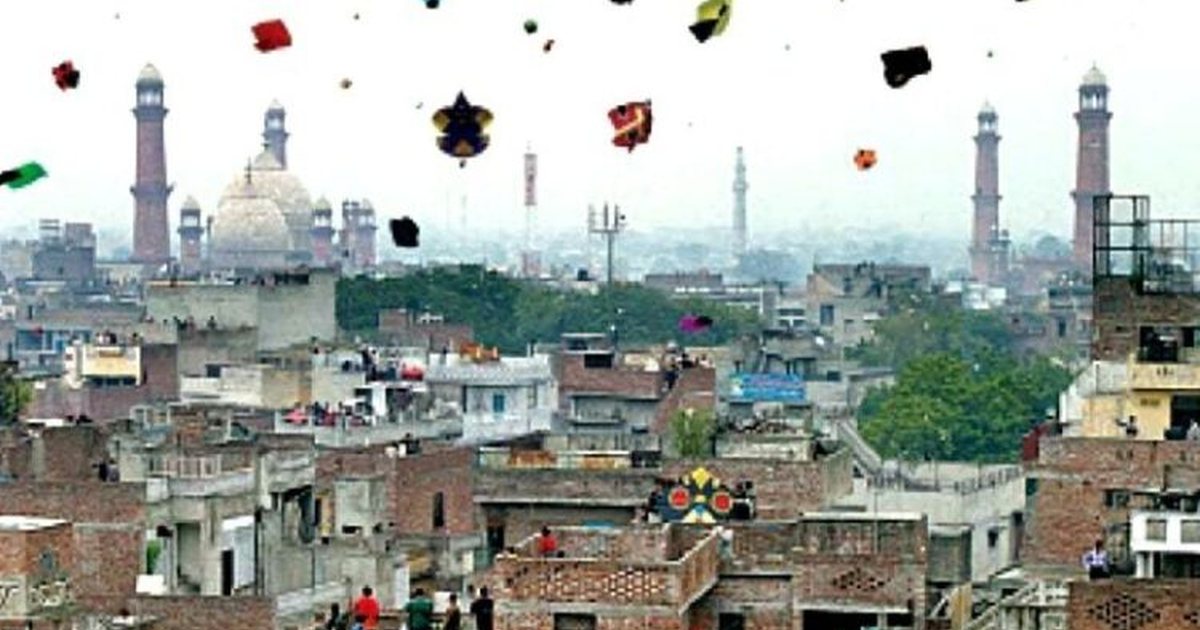
Kite in Urdu is patang (پتنگ). Basant (بسنت) means spring, and in Lahore it is the name of the kite festival that marks it. Everything else on a Basant roof has its own word too, and most of them do not translate neatly into English.
Kite: patang, and the bird
Patang (پتنگ) is the flying toy. The same English word, kite, is also a bird of prey, which in Urdu is cheel (چیل). A search for "kite meaning in Urdu" is asking about one or the other, and on this site it is always the patang.
Kiting is trickier. As an English word it has two unrelated meanings: flying kites, and — in banking — "cheque kiting", writing cheques against money that is not yet in the account. Neither has a single Urdu word. For flying, the everyday term is patang bazi (پتنگ بازی).
Basant
Basant (بسنت) comes from the Sanskrit vasant, spring. In Punjab it has long been a seasonal festival rather than a religious one, and in Lahore it means kites. What Basant is and how it was banned and came back are covered on their own pages.
The kites
| Word | Urdu | Meaning |
|---|---|---|
| Patang | پتنگ | The standard kite, and the general word for any kite |
| Gudda | گڈا | The larger kite, flown for pech |
| Guddi | گڈی | The smaller counterpart, the one children learn on |
| Tukkal | تکل | A tailed kite, slower and steadier |
| Tawa | تاوا | A size grade for guddas, not a shape |
| Githi | گٹھی | The size unit for patang |
What each kite actually is, and which to fly, is on the types of kites page.
The line
| Word | Urdu | Meaning |
|---|---|---|
| Dor | ڈور | Kite line |
| Pinna | پنا | A ball of wound dor — the only legal format in 2027 |
| Charkhi | چرخی | A reel for dor — banned for 2027 |
| Tar | تار | The number of threads twisted together; 9 is the legal maximum |
| Manjha | مانجھا | Coated line — glass or chemical. Banned |
| Kanni | کنّی | The bridle that joins the line to the kite |
Why the charkhi is banned has its own page, and the dor rules cover tar and count.
The contest
| Word | Urdu | Meaning |
|---|---|---|
| Pech | پیچ | Crossing your line with another flyer's to cut it |
| Dheel | ڈھیل | Letting line out fast during a pech |
| Khench | کھینچ | Pulling line in fast during a pech |
| Bo kata | بو کاٹا | The shout when a kite is cut loose |
| Lootna | لوٹنا | Chasing and grabbing a cut kite — the thing never to do |
How a pech is actually fought is on the kite fighting page.
A few more that come up on any Lahore roof:
| Word | Urdu | Meaning |
|---|---|---|
| Kamaan | کمان | The bent cross-spar that gives the kite its bow |
| Kati patang | کٹی پتنگ | A cut kite drifting loose |
| Pinna bharna | پنا بھرنا | Winding dor back onto the pinna |
| Chhat | چھت | The roof, where all of it happens |
Frequently asked
What is kite called in Urdu?
Patang (پتنگ). The bird called a kite in English is cheel (چیل) in Urdu.
What is the meaning of Basant in Urdu?
Basant (بسنت) means spring. In Lahore it is the name of the spring kite festival.
What does kiting mean in Urdu?
For flying kites, the Urdu is patang bazi. In banking, "kiting" means cheque fraud, which has no single Urdu word.
What does bo kata mean?
It is the shout when a kite is cut loose in a pech — roughly "it's cut".
What is pech in kite flying?
Pech is crossing your line against another flyer's and trying to cut it. It is the contest at the heart of Basant.
Kites, dor and everything that goes with them
The 1 tawa gudda is Rs 350 and the 1.5 tawa is Rs 450. Cotton dor on a QR-coded 2-piece pinna is Rs 8,000. See the products and prices.
Selling is paused while our registration is suspended by the Punjab Government — see the notice. The products and prices stay published so you can plan, and we answer questions either way.
- Patang & gudda
- Cotton dor
- Pinnay
- Gloves
- Tape
- Delivery in Lahore