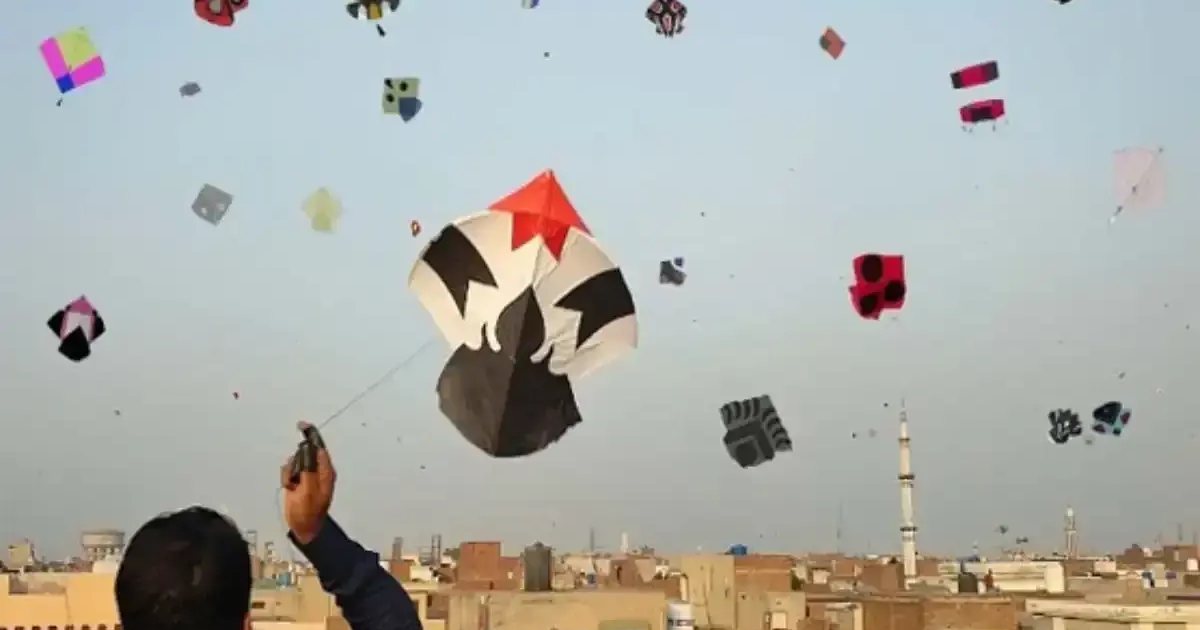
Flying a patang is not difficult, but almost nothing about it is obvious, and most people who fail on their first afternoon fail for the same three reasons: the kanni is wrong, they are trying to run, and the wind is not doing what they think it is.
Before you go up
Check the roof first, because the rules are not optional and the injuries are real. Under the current SOPs, kite flying is permitted only from a secure rooftop with a boundary wall of at least 3.5 ft. Running, jumping and leaning over edges are prohibited, overcrowding beyond the safe load is prohibited, and a first-aid kit is mandatory. Property owners and organisers are jointly liable for accidents, and the compliance deadline was set at 30 December 2026.
Bring: your kites, your pinna, gloves, tape for repairs, and something to drink. Our packs ship with the gloves and tape already in them, which is the part people forget. Gloves are not a nicety. Cotton line under load will open a bare hand, and it happens far more often than beginners expect.
Step 1 — Tie the kanni
The kanni is the short bridle attaching your flying line to the kite's face, and it sets the angle at which the kite meets the wind. It is the single most important adjustment on the whole assembly and the one beginners leave alone when they should be changing it.
On a standard patang the kanni has two legs: one attached near the top of the spine, one lower down. Tie both, bring them together, and knot your dor to the junction.
- Kite climbing too steeply, then stalling and falling back? The junction is too high. Move it down.
- Kite refusing to climb, sitting flat and pulling sideways? The junction is too low. Move it up.
- Kite pulling hard to one side? Your legs are uneven, or the bamboo spine has a kink. Check both.
Adjust in small increments — a centimetre changes the behaviour noticeably.
Step 2 — Read the wind
Stand on the roof and watch something light for a minute: a cloth, a plastic bag, other people's kites. You are looking for steadiness, not strength.
- Steady, consistent pull — good flying. Larger sizes will work.
- Gusty, swirling, dying every minute — common on enclosed roofs in dense neighbourhoods. Stay small. A 1 tawa gudda or a smaller patang will fly when a big one will not.
- Almost nothing — wait. Mornings and late afternoons usually carry the steadiest wind; the middle of the day often goes flat.
The commonest beginner error is buying the biggest kite available for a roof that gets light afternoon wind. Size and price covers matching the two.
Step 3 — Launch without running
You cannot run on a roof, and you do not need to. The rooftop launch is a two-person job the first few times and a one-person job afterwards.
- Have someone hold the kite up at arm's length, face into the wind, about ten to fifteen feet away from you.
- Take up the slack until the line is just taut.
- Say go. They release — release, not throw.
- As it lifts, give a firm, smooth pull on the line, then let a little out. Pull, release. Pull, release.
That rhythm — tug and ease — is the whole technique. Each tug climbs the kite; each ease lets it find its angle. Beginners either hold rigid, which stalls it, or pay out continuously, which drops it.
Alone: hold the kite up in one hand, line taut in the other, release and tug in the same motion. It takes a few attempts.
If it will not go up after several tries, do not pull harder. Bring it down and move the kanni. That fixes it far more often than technique does.
Step 4 — Holding a line
Once it is up, the work is keeping it there. Let line out gradually while the kite is climbing and pulling; wind in when it starts to sag or drift down. Feel for the pull — a kite that has gone slack is about to fall, and a short tug usually recovers it.
Keep the pinna in your non-dominant hand and manage the line with the gloved dominant hand. Never wrap dor around bare fingers, and never around your wrist.
Step 5 — Pech, carefully
Pech is crossing your line against another and cutting it. It is the competitive heart of Basant and the reason the sky over Lahore is a contest rather than a display.
The basics: bring your line across theirs, then work the contact point. Releasing line fast while in contact generally cuts; holding rigid generally gets you cut. Where the lines touch is where the friction is, and cotton against cotton is a fair fight decided largely by handling.
When a line goes, the shout is bo-kata and the kite drifts loose. Do not chase a falling kite off a roof. That instruction reads as obvious and is nevertheless how people die every season.
The string rule, stated once
Only cotton dor is legal — maximum 9 tar, minimum 28 count, wound as a pinna with a QR code. Chemical-coated, glass-coated, nylon and metallic line are banned outright, and charkhi are prohibited. If anyone on your roof produces something that "cuts better", the correct answer is no. The rules on dor in full.
Repairs and endings
Kites tear. A strip of tape across the split on both faces gets a torn kite back up within a minute, and experienced flyers treat repairs as part of the afternoon. A broken spine is different — once the bamboo goes, the geometry is gone.
Stop at dark. Under the SOPs there is no night flying, no aerial firing and no DJ. If someone is injured, Rescue 1122 is the number.
Frequently asked
How do you fly a kite for beginners?
What is kanni in kite flying?
Why won't my kite go up?
Can you fly a kite without wind?
What is pech in kite flying?
Kites, dor and everything that goes with them
We supply complete Basant kits from Lahore — kites in the legal sizes, 100% cotton dor wound on QR-coded pinnay, and the gloves and tape that stop the afternoon going wrong. Matched to work together, at published prices.
- Patang & gudda
- Cotton dor
- Pinnay
- Gloves
- Tape
- Delivery in Lahore
Selling is paused while our registration is suspended by the Punjab Government — see the notice. The packs and prices stay published so you can plan, and we answer questions either way.