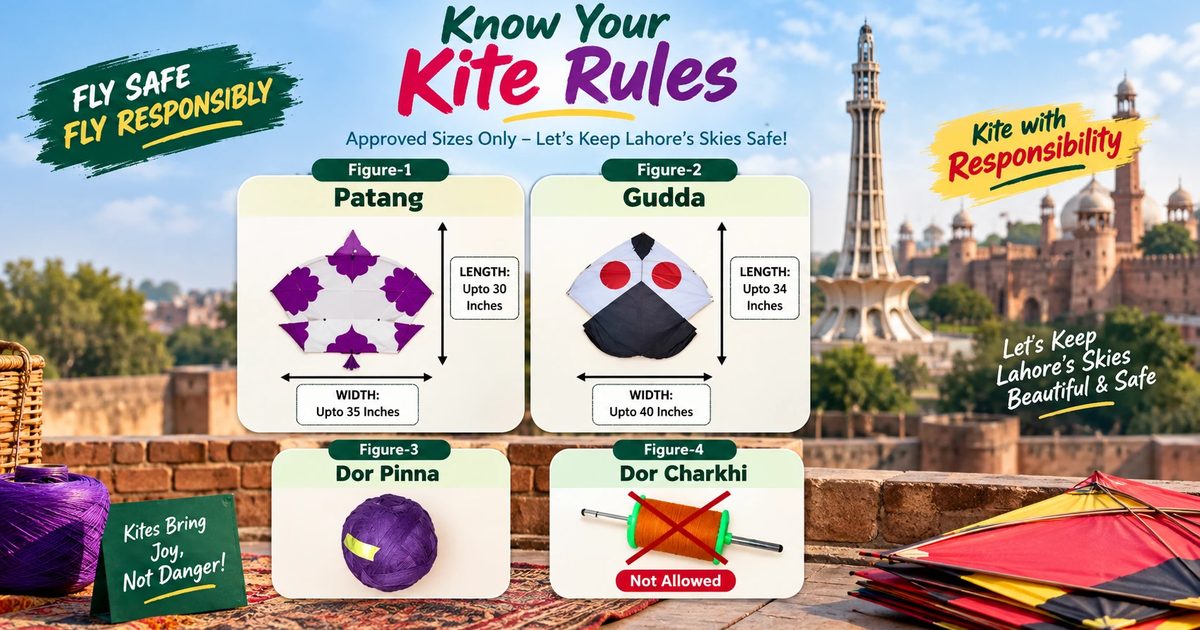
A charkhi (چرخی) is the wooden reel dor is wound on, turned by hand to let line out and take it back in. For generations it was how Lahore flew. For Basant 2027 it is banned: dor must be sold and flown as a pinna, a hand-wound ball.
People are surprised by this one, because a reel looks harmless. This page explains why the rule exists and what flying without one actually involves. What makes dor itself legal is on the dor rules page.
What the rule says
Under the rules notified for Basant, the charkhi is prohibited and dor must be in pinna form. The Punjab kite rules chart puts it in two boxes side by side: pinna permitted, charkhi not allowed. Carrying one onto a roof in Basant week is the easiest way to show a police officer you are not following the rules.
Why a charkhi is banned
Two reasons sit behind it.
Speed. A charkhi lets a flyer pay out and wind in line very fast. That makes aggressive cutting easier, and it makes long, low lines trailing across streets more likely. Those lines are what killed motorcyclists before the ban.
Traceability. The whole 2027 system is built around the pinna. Every lawful pinna carries a QR code tying it to a registered manufacturer. A reel can be wound with anything, from any source, and nothing on it says where the line came from. What the QR code proves.
Flying without a charkhi
It is how most of Punjab flew before reels were common, and it is not hard.
- Hold the pinna in one hand, the line in the other. Let line out by letting the pinna turn in your palm, not by unwinding loops onto the floor.
- Keep the slack off the roof. Line coiled at your feet tangles, and it trips people. If you must lay line down, lay it in long loops away from where anyone walks.
- Wind back onto the pinna in a figure of eight across the ball, not round and round in one place. It stays even and pays out cleanly next time.
- Have a second person manage the pinna in a pech, so the flyer can keep both hands on the line.
The single habit that matters most in a pech without a reel is deciding before the lines touch how much line you are willing to give. With a charkhi, line came off without thinking. With a pinna it has to be paid out by hand, so the flyer and the person holding the pinna need to agree in advance: how much to let out on dheel, and when to stop and pull. Roofs that talk about it before the pech lose fewer kites to tangles than roofs that improvise.
What to do with an old charkhi
Keep it off the roof in Basant week. It is not an offence to own a piece of wood. It is one to fly with it. If it is wound with old line, that line is almost certainly not QR-coded and may not be cotton — how to tell.
Frequently asked
What is a charkhi?
A wooden reel that dor is wound on, turned by hand to let line out and wind it back in.
Is a charkhi allowed for Basant 2027?
No. Dor must be sold and flown in pinna form. The charkhi is prohibited.
Why is the charkhi banned?
It lets line be paid out and wound in very fast, which makes aggressive cutting and long street-level lines more likely. And the QR-code system is built around the pinna.
What is the difference between a charkhi and a pinna?
A charkhi is a reel; a pinna is a ball of wound dor. Only the pinna is legal, and a lawful one carries a QR code.
Can I fly well without a charkhi?
Yes. Let line out by letting the pinna turn in your hand, keep slack off the floor, and have a second person manage the pinna in a pech.
Kites, dor and everything that goes with them
Everything we supply is cotton dor on a QR-coded pinna — a 2-piece pinna is Rs 8,000 — and we do not sell charkhis. The 1 tawa gudda is Rs 350 and the 1.5 tawa is Rs 450. See the products and prices.
Selling is paused while our registration is suspended by the Punjab Government — see the notice. The products and prices stay published so you can plan, and we answer questions either way.
- Patang & gudda
- Cotton dor
- Pinnay
- Gloves
- Tape
- Delivery in Lahore