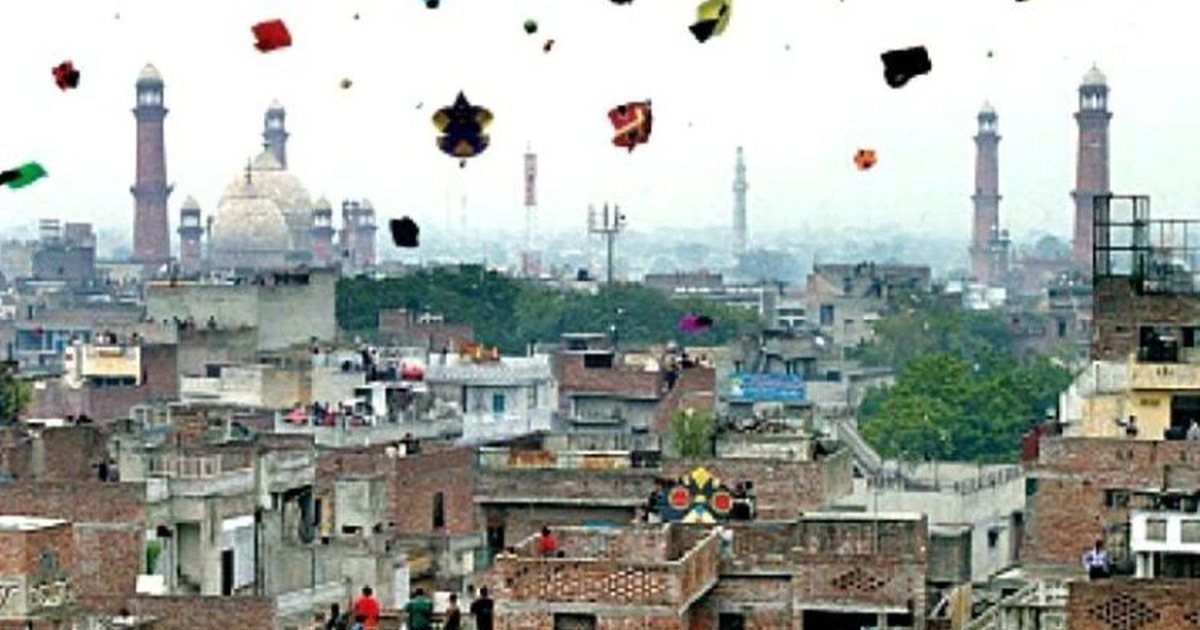
Basant is the spring festival of the Punjab. In Lahore it became something much larger than a seasonal marker — a city-wide event held on rooftops, organised around kite flying, yellow clothing and a particular kind of noise. It is also a festival that was effectively banned for two decades, and that history is the reason the present version looks the way it does.
What the word means
Basant means spring. The word carries the colour yellow with it: basanti is the shade of the mustard fields that bloom around Lahore in late winter, and the yellow clothing worn at Basant is not decorative convention so much as the festival naming itself. The related spring observance across the subcontinent is Basant Panchami, but what Lahore made of it — competitive rooftop kite flying on a city-wide scale — is local and specific.
What actually happens
Basant is not a stadium event. It happens on roofs, which is why no photograph of a single venue ever captures it and why the skyline is the only sensible way to picture it.
Families go up in the morning. Food goes up. Music goes up. The sky fills with kites from mid-morning until well after dark, when flyers switch to white kites picked out by floodlights. The competitive element gives the day its shape: pech is the act of crossing your line against someone else's and cutting it, and bo-kata is what the whole street shouts when a line goes and a kite drifts free. Children chase the fallen ones through the lanes.
The equipment is simple and specific. A patang is the standard diamond kite; a gudda is the larger one. The line is dor, and it is wound on a pinna — a ball, not a reel. If you have never done it, the beginner's guide covers getting a kite up without anyone getting hurt, and our packs put the kites, dor, pinnay and gloves together so nothing is missing on the day.
Why it stopped
The festival did not end because of disapproval. It ended because people were being killed.
As competition intensified, flyers moved from cotton string to materials that cut better: nylon cord, metallic wire, and string coated with abrasive glass or chemical preparations. These hold an edge. Strung taut across a street and effectively invisible, they cut what they meet — and what they met, repeatedly, was motorcyclists at road speed. There were also deaths from falls, from celebratory aerial firing, and from electrocution when metallic line caught overhead power cables.
Court-ordered bans followed from 2005, and legislation hardened around them. For roughly twenty years, Basant in Lahore was something people remembered rather than attended. The full history traces how the festival went from Mughal-era spring custom to prohibited activity and back.
The distinction that explains everything: the ban was never really about kites. It was about string. Every rule in the current framework follows from that one fact.
What brought it back
In December 2025 the Provincial Assembly of the Punjab passed the Punjab Regulation of Kite Flying legislation, replacing prohibition with a licensed, monitored festival. The first legal Basant in about twenty years was held on 6–8 February 2026, with Punjab declaring public holidays on 6 and 7 February.
For 2027 the Government of the Punjab has marked 12, 13 and 14 March 2027 in Lahore. The dates and what has actually been confirmed covers what is notified and what is still pending.
How the regulated festival differs
This is not the old festival with paperwork attached. Several things are genuinely different:
- Defined dates. Three days, set by the province, rather than an open season that crept across weeks.
- Licensed supply. Manufacturers, traders, sellers and kite-flying associations each register in their own category through the Basant Festival 2027 portal, processed via eBiz Punjab and issued by the Deputy Commissioner Lahore.
- Material limits in writing. Kite sizes are capped — patang to 35 in × 30 in (4.5 githi), gudda to 40 in × 34 in (1.5 tawa). Dor must be cotton, maximum 9 tar, minimum 28 count, wound as a pinna carrying a QR code. Charkhi are prohibited.
- Rooftop conditions. Flying is permitted only from secure roofs with a boundary wall of at least 3.5 ft, with first-aid kits required and no running, jumping or leaning over edges.
- Serious penalties. Flying with banned string carries 3–5 years and/or a fine up to Rs 2 million; manufacturing, trading or selling banned material carries 5–7 years and/or up to Rs 5 million. The offences are cognizable and non-bailable, and Punjab Police enforce through the season.
The material rules are set out in full in the legal dor guide, which is the single most important page on this site if you intend to fly.
Is it safe now?
Safer, and conditionally. The framework targets exactly the thing that caused the deaths, and the stated 2027 position is zero tolerance on chemical-coated string and metallic wire. But the framework only works if illegal string stays out of the sky, and enforcement in the run-up to the season has already produced seizures and arrests.
For anyone flying: cotton only, a walled roof, gloves on, children supervised, and Rescue 1122 is the number if something goes wrong.
Where to start
If you are planning for 2027, the useful order is dates first, then rules, then equipment. Dates → what is legal → what things cost → where to buy. If you would rather skip the comparison, see what is in each of our packs and how ordering works.
Frequently asked
What is Basant?
When is Basant 2027?
Why was Basant banned in Pakistan?
Is Basant legal now?
What does basant mean in Urdu?
Kites, dor and everything that goes with them
We supply complete Basant kits from Lahore — kites in the legal sizes, 100% cotton dor wound on QR-coded pinnay, and the gloves and tape that stop the afternoon going wrong. Matched to work together, at published prices.
- Patang & gudda
- Cotton dor
- Pinnay
- Gloves
- Tape
- Delivery in Lahore
Selling is paused while our registration is suspended by the Punjab Government — see the notice. The packs and prices stay published so you can plan, and we answer questions either way.
Sources
- Express Tribune — CM Maryam marks 12–14 March for Basant 2027
- Dawn — Punjab notifies rules for kite flying on Basant (22 Dec 2025)
- ProPakistani — Punjab allows kite flying with new rules
- Basant Festival 2027 portal — Government of the Punjab
- The Punjab Code — Law and Parliamentary Affairs Department