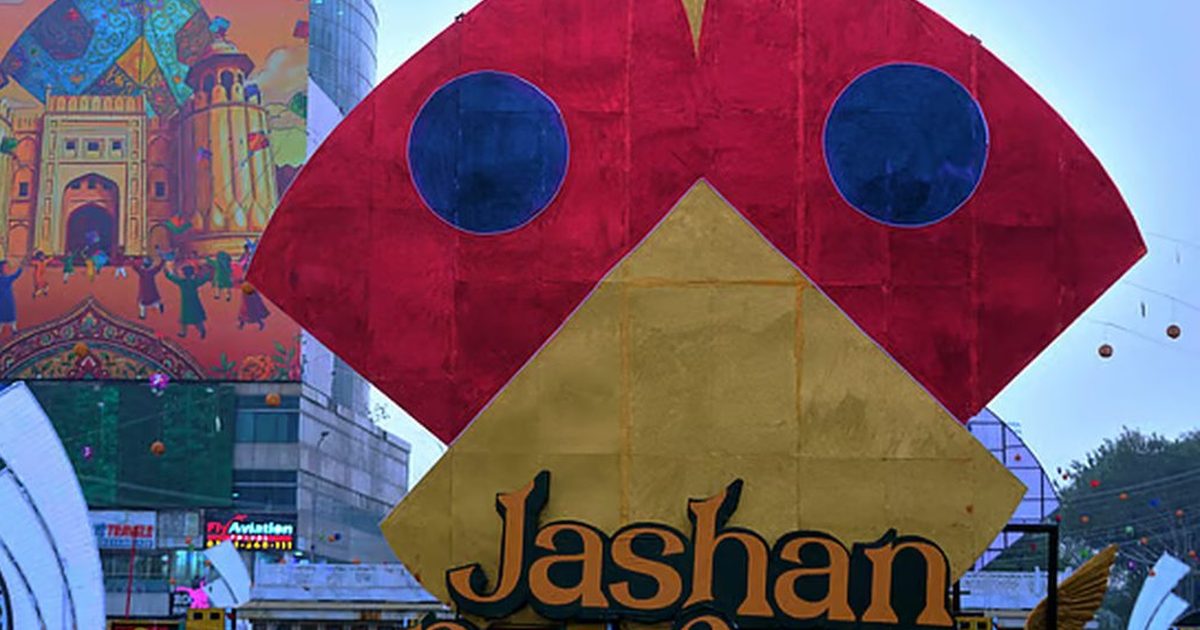
A kite is the cheapest branded object at a Basant activation and the only one that goes two hundred feet up. For the price of a few hundred printed tote bags you can put a mark in the sky over a whole neighbourhood, and the people holding the line are the ones who paid attention to it for an hour.
That is the case for it. The rest of this page is the constraints, because branded kites have four that nobody mentions until the artwork is already approved: what the paper will physically take, what imagery is prohibited outright, what sizes are legal, and how far back from the festival the real deadline sits.
Written for marketing teams, event organisers and anyone sourcing for a venue. If you want a quote, tell us what you need — and read the last section first, because our own seller registration is suspended at present and we will not promise supply we cannot lawfully deliver.
What can be printed, and what cannot
A patang is a sheet of thin paper on a bamboo frame. That single fact decides most of this.
Works. One or two spot colours. Line art. A wordmark. A symbol with clean edges. High-contrast shapes that still read at two hundred feet, which in practice means your logo at roughly the size of a hand. The print goes onto the sheet before the kite is assembled, so the whole face is available.
Works badly or not at all. Photographs and gradients — the paper is absorbent and unforgiving, and a photographic image at that scale is an invisible smudge in the sky anyway. Dense solid coverage across the whole face: ink adds weight and stiffens paper, and a kite is a flying surface before it is a billboard. Heavy coverage changes how it takes the wind, and a brand's kite that flies badly is worse advertising than no kite.
The other print surfaces people forget. The pinna that the dor is wound on takes a label, and a lawful one already carries a QR code — there is room beside it. Gloves and tape take print easily and come back to the office in somebody's bag, which a kite does not.
Not available. The kanni — the bridle line — and the frame. Nothing goes on either without changing the flight.
The imagery that is banned, before you commission the artwork
This is the compliance point that catches brands, and it is not in any design brief:
Religious and political imagery on kites is prohibited. Ahead of Basant 2026 Punjab enforced Section 144 specifically to bar religious and political imagery on kites, with a thirty-day ban on kites carrying it. Anything that reads as a party symbol, a flag, a religious text or a political slogan is out, and the margin for interpretation on a festival weekend belongs to the enforcing officer, not to your agency.
In practice: no national or party colours arranged as a flag, no crescent-and-star devices, no Arabic calligraphy as decoration, no candidate, no slogan that could be read as a campaign. A commercial wordmark is a commercial wordmark and is fine. If a design would make a district administration pause for even a second, change it rather than argue it — a consignment stopped on 11 March is a consignment that does not exist.
Size: there is no such thing as a giant brand kite
Punjab publishes maximum dimensions, and the allowed sizes are the sizes — a patang at 35 × 30 inches and a gudda at 40 × 34. A 6-foot display kite with a logo on it is not a large order, it is an unlawful one.
If you need scale, scale the quantity, not the kite. Two hundred 1-tawa guddas over one street is a bigger visual event than one oversized kite nobody is allowed to fly.
The line matters as much as the kite
A brand that hands out compliant kites with non-compliant line has handed out a problem with its name printed on it. Every spool at your activation needs to be cotton, within the published tar limit, on a QR-coded pinna — the dor rules are specific, and chemical dor and manjha is what the whole regime exists to stop. Gloves for anyone who will actually fly.
If you are sponsoring or supplying a ticketed venue, there is a further mechanism worth knowing: in 2026 the SOPs meant ticket holders had to buy their kites and material from the on-site vendors, so the venue controlled every item inside the fence. That makes the vendor slot, not the goodie bag, the thing to negotiate for — see tickets and venues.
The timeline, counted backwards from 12 March
Basant 2027 is announced for 12 to 14 March, with cabinet approval still pending. Working back:
- The festival days. Nothing can be fixed in them.
- Delivery, the week before. By hand or by a seller's own rider. Kites and dor cannot lawfully travel by courier, post or delivery platform in Punjab, which means a brand in Karachi cannot have branded kites shipped to a Karachi office. Plan the activation where the goods can lawfully be.
- Assembly. Printed sheets become kites by hand, kite by kite.
- Print and dry. Paper, then drying time, then cutting.
- Artwork sign-off. The slowest step in every project, and the one with your internal approvals in it.
- Seller registration. The registration phase for sellers is reported for January–February 2027, which is the real gate on anyone's ability to supply you lawfully. Nothing before it is a confirmed order from anybody.
Which means the honest planning advice is: agree the design and the quantities in November and December, and expect the contract to be contingent on registration. A supplier who promises you a firm March delivery today either does not know the regime or is counting on you not to.
What we can and cannot do right now
We can talk specification, quantities, artwork feasibility and what a roof or a venue actually gets through. We can quote indicatively against published prices.
We cannot sell. Our registration is suspended by order of the Punjab Government — the notice is on the homepage — and supply begins when it is reissued. We would rather say that in the first conversation than in the last one.
Frequently asked
Can you print a company logo on kites in Pakistan?
Yes. The print goes onto the paper before the kite is assembled, and one or two spot colours with clean edges work best. Photographs, gradients and heavy all-over coverage do not — ink adds weight and stiffens paper, which changes how the kite flies.
Is there a minimum order for branded kites?
It depends on the print method and the artwork, so ask rather than assume. Printing is set up per design, which means the cost per kite falls steeply with quantity and a very small run is usually not worth printing at all.
What imagery is not allowed on a kite?
Religious and political imagery. Ahead of Basant 2026 Punjab enforced Section 144 to bar it specifically, with a thirty-day ban on kites carrying it. Commercial wordmarks and brand devices are not affected, but anything resembling a flag, a party symbol, a religious text or a political slogan should be redesigned.
Can we make an oversized kite with our branding?
No. Punjab publishes maximum kite dimensions — 35 × 30 inches for a patang and 40 × 34 for a gudda — and an oversized kite is unlawful rather than impressive. Scale the quantity instead.
How far in advance should a brand order kites for Basant?
Agree design and quantities in November or December for a March festival. Artwork sign-off, printing, drying and hand assembly all take time, delivery has to be by hand or a seller's own rider because courier and postal carriage is prohibited in Punjab, and the seller registration phase reported for January–February 2027 is the gate on any supplier's ability to confirm.
Kites, dor and everything that goes with them
Kites by the tawa grade, 100% cotton dor on QR-coded pinnay, gloves and tape — all sold singly from Lahore at a published price, delivered by our own rider. See the products and prices.
Selling is paused while our registration is suspended by the Punjab Government — see the notice. The products and prices stay published so you can plan, and we answer questions either way.
- Patang & gudda
- Cotton dor
- Pinnay
- Gloves
- Tape
- Delivery in Lahore