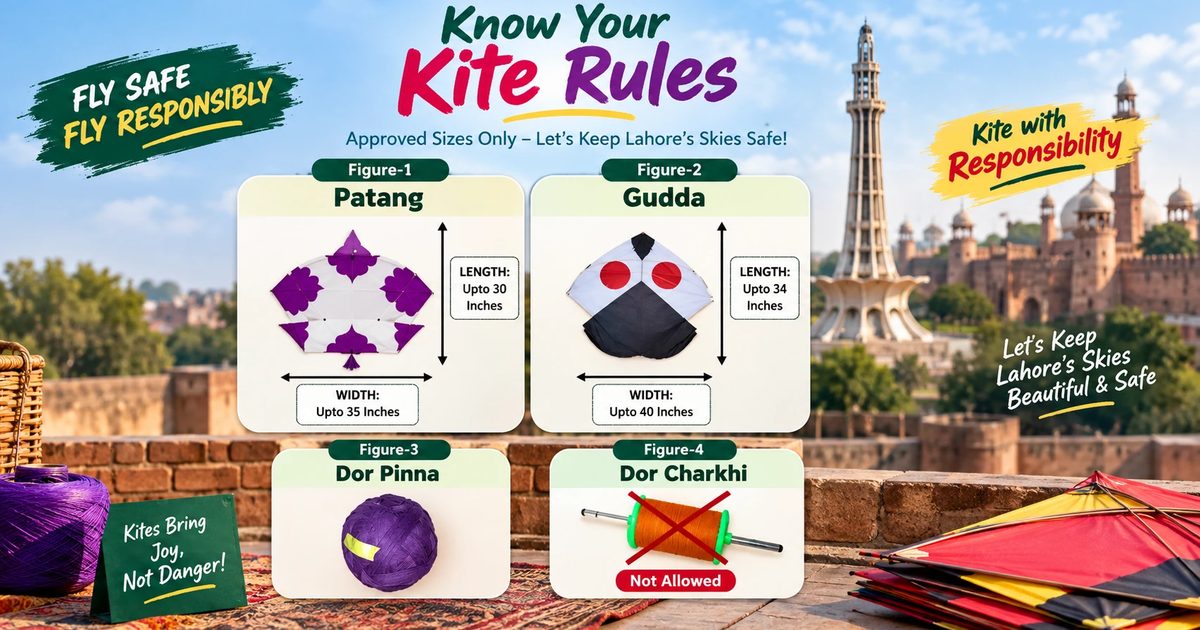
Punjab sets a hard ceiling on how big a kite may be, and it is written in inches rather than in trade sizes. A patang may not exceed 35 inches in width and 30 inches in length; a gudda may not exceed 40 inches in width and 34 inches in length. Those figures come from the rules notified under the kite flying framework and are reported in full by Dawn.
The Lahore administration has been explicit that only kites of approved sizes and cotton string will be permitted, with zero tolerance for chemical-coated string and metallic wire. Size is not a guideline this season.
The two limits
| Kite | Trade maximum | Legal maximum |
|---|---|---|
| Patang | 4.5 githi | 35 in wide × 30 in long |
| Gudda | 1.5 tawa | 40 in wide × 34 in long |
Githi and tawa are the trade's own size units and the rules quote both alongside the inches, which is useful because no shop in Lahore sells by the inch. What the table means in practice is that 1.5 tawa is the ceiling, not a grade above which more exists. If someone offers you a 2 tawa, they are offering you an offence.
What the names actually mean — patang, gudda, guddi, tawa, githi — is worth five minutes if any of this vocabulary is new.
How to check a kite
Measure the width first. Width is the long cross-measure, spine to spine at the widest point, and it is the dimension that breaches the limit first.
Then the length, top to bottom along the spine.
Compare against the right row. A big kite is not automatically a gudda for legal purposes — measure it and see which category and limit it falls under.
Ask the grade and then verify it. A kite sold as 1.5 tawa should measure at or under 40 × 34. Paper stretches, frames vary, and the batch matters more than the label.
Check the QR code while you are at it. Legal stock is traceable to a registered manufacturer, which is what the QR system is for.
Why the limit exists
A bigger kite pulls harder. More pull means a heavier line, a firmer grip, and much more stored energy in anything that comes down across a road or a wire. The size cap and the cotton-only dor rule are two halves of the same safety argument: cap the force, and make sure the line that transmits it breaks before a person does.
It also makes enforcement possible. An inspector cannot assess how hard a kite pulls, but anyone can hold a tape measure against it.
What happens if a kite is oversized
For a seller, it is straightforward: dealing in kites outside the approved specification is an offence under the Act, carrying five to seven years and a fine up to Rs 5 million, and it is non-bailable.
For a buyer, an oversized kite is stock that can be seized, on a roof that can be shut down, bought from someone who by definition is not operating within their registration. There is no version of this where the oversized kite is the good purchase.
What we stock, and why
Two grades, both inside the limit. The 1 tawa is about 35 inches wide — the everyday gudda, and the size that actually flies in ordinary Lahore wind. The 1.5 tawa is 40 × 34 inches: the legal ceiling exactly, for steady wind and a firmer line.
We stock nothing above 1.5 tawa and will not order it in. That is not caution, it is the specification our registration binds us to.
Frequently asked
What is the maximum kite size allowed in Punjab?
What size is a 1.5 tawa kite?
What does githi mean?
Are 2 tawa kites allowed at Basant 2027?
How do I know a kite is a legal size?
Kites, dor and everything that goes with them
Everything sold singly from Lahore, at a published price — kites by the tawa grade, 100% cotton dor on QR-coded pinnay, and the gloves and tape that stop the afternoon going wrong. Buy only what you need.
- Patang & gudda
- Cotton dor
- Pinnay
- Gloves
- Tape
- Delivery in Lahore
Selling is paused while our registration is suspended by the Punjab Government — see the notice. The products and prices stay published so you can plan, and we answer questions either way.