Ask anyone in Lahore for a Basant song and you will get one answer, and it has been the same answer since 1996.
Fariha Pervez's "Patang Baaz Sajna" — which nobody calls that. Everybody calls it "Bo Kata", after the shout in it. It came out in 1996 on her debut album Nice & Naughty, became an immediate hit, and launched the career that followed. Thirty years later it is the thing that gets put on when the first kite goes up, to the point where one write-up of its anniversary put it plainly: the celebration is considered incomplete without it.
That is unusual. Most festivals accumulate a dozen songs and no single anthem. Basant has one, and the reason is probably in the title: bo kata is not a sentiment about spring, it is the specific noise a roof makes at the moment a line goes. The song is named after the event it soundtracks.
The remake, and why it exists
Pervez re-recorded it for the festival's return, as "Dil Hua Bokata". She told an interviewer that it felt as though "Bo Kata" had just been released again — which is the honest description of what happened to the song in 2026. It had spent eighteen years as the soundtrack to a festival that was banned. When the ban lifted, a generation that had only heard it on old recordings heard it over a sound system with kites actually in the air.
Worth separating from the song: "Bo Kata" is also the name of a 2007 documentary by Shehzad Afzal about Lahore's kite culture, with an original score by John Walden. Same title, different work, and the two get mixed up in search results constantly. If you are looking for the film, you want the documentary. If you are looking for the thing your uncle plays on the roof, you want the 1996 single.
What actually played at the 2026 festivals
The ticketed venues sold music as much as kites, and their line-ups are the clearest record of what the festival sounds like now rather than in 1996.
- POP Basant Fest advertised Abrar-ul-Haq, Young Stunners, HAVI and Faris — which is to say one Punjabi pop institution and three acts from the rap-and-pop end of the current scene, on the same bill.
- Basant Fest at Defence Raya Fairways listed Abrar-ul-Haq as well, billed for Punjabi hits and sing-alongs.
Abrar-ul-Haq is the connective tissue there. His debut Billo De Ghar is the Punjabi pop record that a Lahore roof has been playing in some form for decades, and a Basant bill without him would be a strange one. One 2026 upload also promoted a track of his as that year's Basant anthem; that was the uploader's claim rather than anyone else's, and the song has not displaced "Bo Kata".
The sounds that are not music
A roof at full tilt has a soundtrack that no playlist contains, and if you have never been on one, this is most of it:
The shout. Bo kata goes up from a roof two streets over before you see whose kite came down. Then it travels — one roof picks it up from the next, and for ten seconds the whole mohalla is shouting about a cut nobody on your roof witnessed.
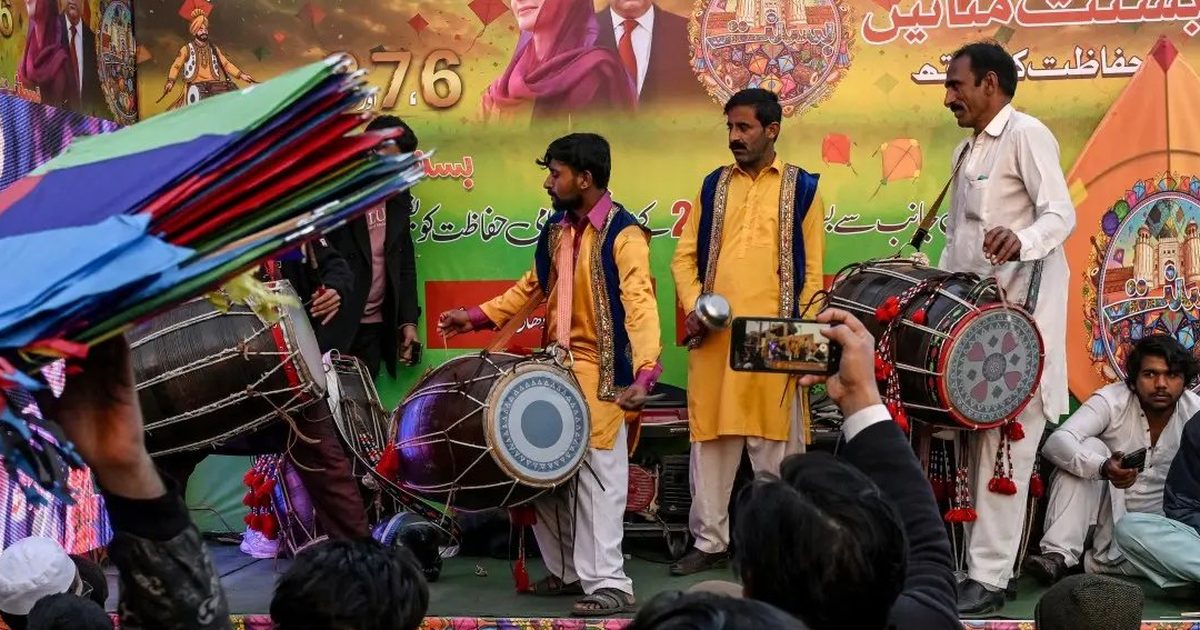
The dhol. On the denser roofs around the Walled City somebody will have brought one, and a dhol does something a speaker cannot, which is make the floor move.
The line. A pech is audible. Two cotton lines dragging across each other make a dry rasp, and the khench that follows is a snap of released tension. Good flyers listen for it as much as they watch for it — how a pech is won is partly an argument about sound.
Horns, and then nothing. Traffic noise comes up off the streets all afternoon, and then at dusk the sky empties and it stops, all at once.
The one rule about volume
Before you plan a sound system: DJ systems and high-decibel sound are prohibited under the Basant SOPs, as noise pollution and a disturbance of public order. That is not a guideline, it is in the rules that govern whether your roof is compliant, and it is set out in full on Basant 2027 SOPs and rooftop rules.
What that leaves is plenty. A domestic speaker at conversational volume, which is what most roofs run anyway, because above that you cannot hear the shout from the next roof and the shout is half the point. If you are putting a roof together, the kit list covers where to put the speaker so it is not the thing your line catches on.
Building a roof playlist that fits the day
Three practical notes, from the shape of the day rather than from taste.
Mornings are quiet. The wind in Lahore is usually not worth much before mid-morning, and the roof fills slowly. Nobody wants an anthem at nine.
The middle of the day is loud and social. This is where Punjabi pop belongs — the Abrar-ul-Haq end of the catalogue, songs people can shout along to while holding a pinna in the other hand.
Keep "Bo Kata" for the first real cut. It works best as a punctuation mark rather than background. Put it on when somebody on your roof wins a pech and the whole thing lands.
And a fourth, which is not about music: the loudest part of the day should still be the people. A roof where the speaker wins is a roof where somebody steps backwards into a parapet they could not hear anyone warning them about. Twelve of 2026's seventeen deaths in Lahore were falls from roofs.
Frequently asked
What is the most famous Basant song?
"Patang Baaz Sajna" by Fariha Pervez, universally known as "Bo Kata", first released in 1996 on her debut album Nice & Naughty. It is treated as the festival's anthem and she re-recorded it as "Dil Hua Bokata" for Basant's return.
Why is the song called "Bo Kata"?
Its actual title is "Patang Baaz Sajna", but it is named in everyday use after the shout inside it — the cry that goes up from a roof when a line is cut. The nickname stuck so thoroughly that almost nobody uses the real title.
Who performed at Basant 2026 in Lahore?
The ticketed festivals advertised Abrar-ul-Haq, Young Stunners, HAVI and Faris at POP Basant Fest, with Abrar-ul-Haq also billed at Basant Fest at Defence Raya Fairways. The city-wide festival on ordinary rooftops had no line-up at all.
Is "Bo Kata" a song or a film?
Both, and they are unrelated. The 1996 song is Fariha Pervez's. Bo Kata is also a 2007 documentary about Lahore's kite culture by Shehzad Afzal, scored by John Walden.
Can I play music on my roof during Basant?
At ordinary volume, yes. DJ systems and high-decibel sound are prohibited under the Basant SOPs as noise pollution and a disturbance of public order, so a domestic speaker is the right scale for a rooftop.
Kites, dor and everything that goes with them
Kites by the tawa grade, 100% cotton dor on QR-coded pinnay, gloves and tape — all sold singly from Lahore at a published price, delivered by our own rider. See the products and prices.
Selling is paused while our registration is suspended by the Punjab Government — see the notice. The products and prices stay published so you can plan, and we answer questions either way.
- Patang & gudda
- Cotton dor
- Pinnay
- Gloves
- Tape
- Delivery in Lahore