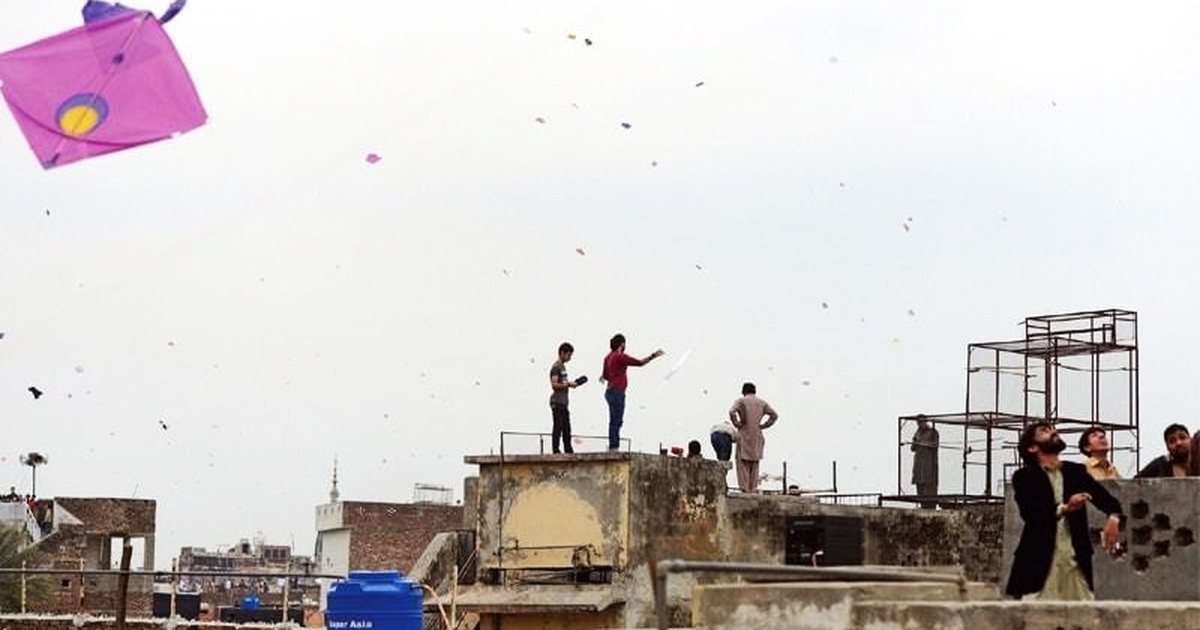
Twelve of the seventeen people who died at Basant 2026 fell from roofs. Not string — roofs. That single figure, from the Home Department's own report to the Lahore High Court, is why the 2027 rules are mostly about parapet walls, and it is the fact a parent should carry up the stairs.
The rules themselves say children must be supervised continuously and must not be near rooftop edges without an adult. That is the rule, and the SOPs page sets it out with the rest. This page is about the judgement the rule does not make for you: what a child can actually be allowed to do up there, and when.
The two rules that carry most of the risk
Everything else is detail next to these.
One adult, one child, eyes on. "Supervised" does not mean present on the same roof. A crowded Basant roof at four in the afternoon, with forty people all looking upward and moving backwards, is a place where a small child can be out of sight in four seconds. If you are flying seriously, you are not supervising. Someone has to be doing only the one job.
Nobody goes near an unwalled edge. The standard is a parapet of at least 3.5 feet, structurally sound. Check it yourself before the children come up, and check the corners and the stairwell opening too — those are where the gaps are. If the wall is short, that is not a roof to bring children onto, whatever else is true about it.
What a child can do, roughly by age
There is no legal age for this and there should not be a rigid one — children differ. But the tasks divide fairly naturally.
Under about 5. On the roof, held or in reach, well back from the edge, watching. Nothing in their hands. A small child does not understand that a line under tension is dangerous, and cannot be expected to.
Around 5 to 8. Holding a kite for a launch, winding a pinna, fetching, watching for the neighbour's cut kite. Not holding a working line — a kite that catches wind pulls harder than a small child expects, and the instinct is to grip, which is exactly what cuts. This is the age that most wants to hold the line and is least ready to.
Around 9 to 12. Flying a small kite on their own line, with an adult beside them and gloves on. A 1 tawa kite in ordinary wind is the right thing at this age — not because it is a toy but because it is proportionate. Not pech; losing a pech means a line running out fast through your hands.
Teenagers. Flying properly, with the same equipment and the same rules as everyone else. The supervision requirement still applies, and the roof edge still applies.
Hands
Hands are where children who are flying get hurt, and it is entirely preventable.
Line running through bare fingers under load cuts — not the dramatic injury that makes the news, but the ordinary one that ends the afternoon. Gloves and tape are per person, not per roof, and a child's hands need them more than an adult's, not less. The quantities are on the kite list.
The one to watch for is a child grabbing at a line that is already running. Teach the opposite instinct before you go up: let it go. A lost kite costs Rs 350. A hand does not.
The street is the real danger
The roof is the risk parents think about. The street is the one that actually caught children in 2026.
An eight-year-old girl in Gulshan-e-Ravi was cut on the throat by a string that fell on her. Two boys, twelve and fourteen, were injured on Ravi Road — while chasing kites.
Chasing a fallen kite is the single most dangerous thing a child does at Basant. It puts them in traffic, at speed, looking up. Whatever else you agree before going up, agree this one: a kite that goes is gone.
The kite string injuries page covers the ground-level risk and what to do if someone is cut.
Check these first
- Walk the roof yourself first. Parapet, corners, stairwell, anything to climb on.
- Agree the two rules out loud: stay back from the wall, never chase a kite.
- Gloves on the children who will hold a line.
- One adult whose only job is the youngest child.
- Know where the first-aid kit is. Required at designated venues, and worth having anyway.
- Closed shoes. A roof is a hard, crowded, uneven surface.
Frequently asked
What age can a child fly a kite at Basant?
Around 9 to 12 for a small kite on their own line with an adult beside them and gloves on. Younger children can help launch and wind without holding a working line.
What do the Basant 2027 rules say about children?
Parents and guardians must supervise children continuously, and children must not be near rooftop edges without adult supervision.
What is the biggest danger to children at Basant?
Two: falling from a roof, which is what killed most of the people who died in 2026, and chasing fallen kites into traffic, which is how several children were injured.
Do children need gloves for kite flying?
Yes, more than adults do. Line under load cuts bare fingers, and a child's instinct when a line runs is to grip it.
How high does a rooftop wall need to be for children to be safe?
The standard is at least 3.5 feet and structurally sound. Check the corners and the stairwell opening as well as the main parapet.
Kites, dor and everything that goes with them
A 1 tawa kite at Rs 350 is the right first kite — about 35 inches, inside the legal limit, and the size that flies in ordinary Lahore wind. Gloves are per person. Everything sold singly from Lahore at a published price. See the products and prices.
Selling is paused while our registration is suspended by the Punjab Government — see the notice. The products and prices stay published so you can plan, and we answer questions either way.
- Patang & gudda
- Cotton dor
- Pinnay
- Gloves
- Tape
- Delivery in Lahore